. . . something mysterious is at work in the universe
– Physicsworld.com.
When I had a real job (at a company called Itek Optical Systems), I had the privilege of working on the Hubble Space Telescope studies and the W. M. Keck telescope primary mirror fabrication proposal. As a young engineer, I was so excited to be involved, even in a small way, in the initial stages of these new “eyes on the sky”. I wondered what great mysteries these instruments might some day reveal. Now I know.
In 1998, using data from Hubble and Keck (and other telescopes), physicists Saul Perlmutter of Lawrence Berkeley National Laboratory, Brian Schmidt of the Australian National University, and Adam G. Riess of Johns Hopkins University made the most significant cosmological discovery since the Cosmic Microwave Background in 1965. For this, they were awarded the 2011 Nobel Prize in physics.
Like so many, their discovery came as a complete surprise.
Per cosmological models, physicists in the late 20th century believed gravity should be slowing the expansion of the universe. What was needed was observational data to confirm this theoretical prediction.
So in 1998, two independent teams led by Perlmutter (the Supernova Cosmology Project), and Schmidt/ Riess (the High-Z Supernova Search) tried to measure exactly how much the expansion of the universe is being slowed by gravity. And by measuring this “deceleration parameter” they hoped to also get a better indication of the total amount of matter/energy in the universe.
The idea was to utilize Hubble, Keck, and other telescopes to examine the brightness and redshift of some one hundred or so type 1a supernovae:
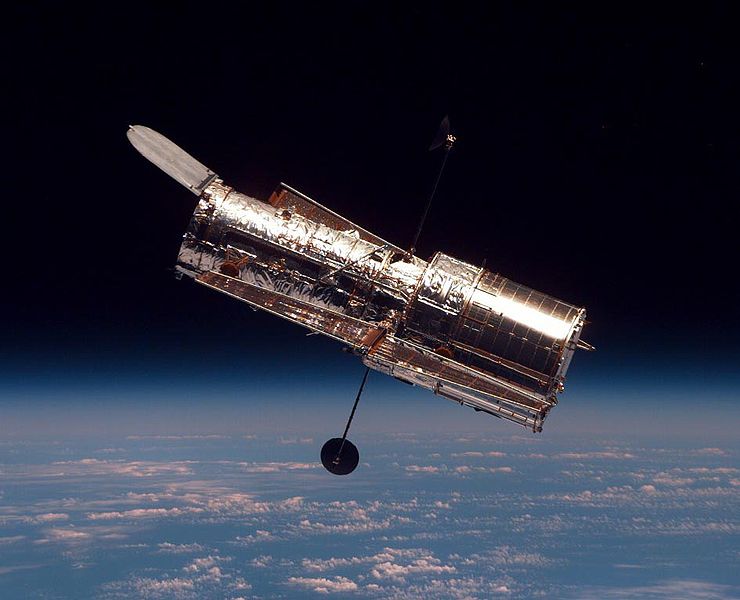
Hubble and supernova brightness – The 2.4 meter Hubble Space Telescope in low Earth orbit was involved in the measurement of the brightness of these type 1a supernovae. Why type 1a? Because physics predicts these supernovae all produce about the same luminosity. (Luminosity is the amount of light an object gives off.)
Just like car headlights, a supernova appears dimmer the further away it is. So by measuring its apparent brightness as seen from Earth and comparing it to its luminosity, the physicists determined how far away it was, i.e. its distance from us.
And since light from a supernova explosion travels at the speed of light c, knowing its distance from us told them how long ago the supernova light was emitted — or when each supernova explosion occurred.
Keck and supernova redshift – 13,600 feet high on Mauna Kea in the big island of Hawaii, the ten-meter Keck telescope and its LRES spectrometer were involved in the determination of the redshift of these type 1a supernovae. This told the physicists how much the universe has expanded since the supernova explosions.
Say a supernova is 10 billion light-years away. This means it takes 10 billion years for its light to reach us here on Earth. During that time, the universe has expanded — stretching the wavelength of the supernova light as it makes its journey to us. So the supernova light arrives at Earth at a lower frequency — shifted towards the red end of the spectrum.
Thus the amount of redshift reveals how much the universe has expanded in the time it took the supernova’s light to travel to the Earth.
Together, the data from Keck, Hubble, and other telescopes told Perlmutter, Schmidt, and Riess when each supernova was born and how much the universe has expanded since.
The results were shocking, to say the least. Distant supernovae were dimmer than expected. This meant they were further away than initially thought. So their light must have taken longer to get here. Thus these supernovae were born earlier in time than expected.
Therefore the measured expansion amounts (redshifts) associated with these distant supernovae occurred earlier than expected. So the universe must be expanding faster than expected.
To see this, imagine the surface of a balloon expanding as you blow it up. You expect it to be a certain size at a certain time. But when you measure it, you find it reaches that size sooner than you thought. So, you conclude, the balloon must be expanding faster than you thought.
From all this, Perlmutter and Schmidt/Riess concluded the expansion of the universe did slow at first — but for the past 5 to 7 billion years, the expansion of our universe has been speeding up!
Later observations of over two hundred type 1a supernovae confirmed this analysis — the expansion of the universe is indeed accelerating. Data from the Wilkinson Anisotropic Probe (WMAP), the Two-Degree Field (2DF), and the Sloan Digital Sky Survey (SDSS) support this conclusion.
What causes this acceleration? Physicists have no idea. Some postulate our entire universe is filled with a kind of repulsive energy dubbed “dark energy”. Exactly what this so-called dark energy is remains one of the great unsolved mysteries of modern physics.
For details, see Perlmutter’s article: http://supernova.lbl.gov/PhysicsTodayArticle.pdf
I welcome all comments — pro and con.
My website: marksmodernphysics.com
References for this article:
1) Imagine the Universe! http://imagine.gsfc.nasa.gov/docs/science/mysteries_l1/dark_energy.html
2) B. Rosenblum, F. Kuttner, Quantum Enigma, p. 196.
3) B. Greene, The Fabric of the Cosmos, p. 297.
4) “Dark Energy”, Physicsworld.com, May 30, 2004. http://physicsworld.com/cws/article/print/19419
23. I do not even know how I ended up here, but I thought this post was good. I don’t know who you are but definitely you’re going to a famous blogger if you aren’t already 😉 Cheers!
I’m not that much of a online reader to be honest but your sites truly good, maintain it up! I’ll go ahead and bookmark your site to come back later on. Cheers.
The next period I learn a website, I hope that it won’t dissatisfy me as being a lot since this one. I mean, I know it had been my substitute for learn, nevertheless I seriously assumed you’d have one thing attention-grabbing to say.
I just added this website to my bookmarks. I enjoy reading your posts. Thank you!
There is apparently a bundle to know about this. I suppose you made certain good points in features also.
Fascinating blog! Is your theme custom made or did you download it from somewhere? A theme like yours with a few simple tweeks would really make my blog stand out. Please let me know where you got your theme. Thanks a lot
From WordPress.
Hi there just wanted to give you a quick heads up. The words in your content seem to be running off the screen in Opera. I’m not sure if this is a formatting issue or something to do with web browser compatibility but I figured I’d post to let you know. The style and design look great though! Hope you get the issue fixed soon. Many thanks
Hi there are using WordPress for your blog platform? I’m new to the blog world but I’m trying to get started and create my own. Do you need any html coding knowledge to make your own blog? Any help would be greatly appreciated!
I don’t know. I am using the blog format avaliable on scienceforums.
Thanks on your marvelous posting! I genuinely enjoyed reading it, you could be a great author.I will remember to bookmark your blog and definitely will come back sometime soon. I want to encourage you continue your great posts, have a nice day!
I have learn several just right stuff here. Definitely price bookmarking for revisiting. I surprise how a lot effort you put to create the sort of fantastic informative web site.
I have recently started a blog site, the info you offer on this internet site has helped me greatly. Many thanks for all of your time and work.
With havin so much written content do you ever run into any issues of plagorism or copyright violation? My site has a lot of unique content I’ve either created myself or outsourced but it seems a lot of it is popping it up all over the web without my agreement. Do you know any ways to help protect against content from being ripped off? I’d truly appreciate it.
Sorry, no I don’t. Maybe ask a lawyer.
I do not even know how I stopped up right here, however I believed this publish was once good. I do not know who you’re however certainly you are going to a well-known blogger if you are not already. Cheers!
Good post. Its realy good info for us. Thanks a lot!
Great beat ! I wish to apprentice while you amend your site, how can i subscribe for a weblog site? The account aided me a applicable deal. I have been tiny bit acquainted of this your broadcast provided bright transparent idea
Wonderful work! That is the type of information that should be shared around the net. Shame on Google for no longer positioning this put up higher! Come on over and visit my web site . Thank you =)
Hey! This is my first comment here so I just wanted to give a quick shout out and say I genuinely enjoy reading through your articles. Can you recommend any other blogs/websites/forums that cover the same subjects? Thank you!
Try Decoded Science
Hi there , I am making a new forum and I think some of your articles would really fit in well. Would you let me link back to your website?
Sure. Thanks.
Thank you for sharing it with us, i will be back again.Respectfully – Evelin from gejownia.pl
Great blog here! Also your web site loads up very fast! What web host are you using? Can I get your affiliate link to your host? I wish my site loaded up as fast as yours lol
Its scienceforums.net
Its scienceforums.net
I truly appreciate this post. I’ve been looking everywhere for this! Thank goodness I found it on Bing. You have made my day! Thanks again
Hello there, just turned into aware of your weblog thru Google,my site is http://www.chilggoooto.com
Pretty nice post. I simply stumbled upon your blog and wished to mention that I have really enjoyed browsing your weblog posts. After all I will be subscribing in your rss feed and I’m hoping you write once more soon!
Nice post. I was checking constantly this blog and I am impressed! Very helpful information particularly the last part 🙂 I care for such info much. I was seeking this certain info for a very long time. Thank you and good luck.
How does one make money from blogs? How does one go about it or start it?
I simply had to appreciate you once more. I’m not certain the things I would have created without these thoughts discussed by you over such a field. It became the frightening situation for me personally, but noticing the very expert way you resolved that forced me to jump over gladness. Extremely thankful for your work and as well , hope you know what an amazing job you have been undertaking instructing many people by way of your webpage. I am certain you’ve never encountered all of us.
Hello.This post was extremely remarkable, especially since I was looking for thoughts on this matter last couple of days.
Hello, i feel that i saw you visited my weblog thus i got here to “return the want”.I am attempting to to find issues to improve my website!I guess its good enough to use some of your ideas!!
Thank you your submission, it is interesting and compelling. I discovered my way here through Google, I will come back one more time 🙂
I actually planned to compose a small note to thank for you for some of the pleasant secrets you are showing on this website.
Thanks for your submission, previously it was interesting and compelling. I stumbled upon my way here through Google, I’ll return one more time 🙂
Many thanks for your submission, previously interesting and compelling. I found my way here through Google, I’ll return over again 🙂
Hello there, simply changed into aware of your weblog thru Google,my site is http://www.chilggoooto.com
I actually wished to compose a small note to thank for you for a number of the pleasant secrets you might be showing on this internet domain.
Youre so cool! I dont suppose Ive learn something like this before. So nice to find any person with some authentic thoughts on this subject. realy thanks for beginning this up. this web site is something that is wanted on the net, somebody with a little bit originality. helpful job for bringing one thing new to the internet!
I like the layout on this blog. Would you let me know where you can get it? Thanks a lot!
It was an option when I started the blog under WordPress
Article of such quality as to The New York Times
I have learn several good stuff here. Certainly value bookmarking for revisiting. I surprise how so much attempt you set to create the sort of excellent informative web site.
Pretty superior post. We just discovered your site and wanted to point out that We have actually enjoyed reading your blog and content. Anyways I’ll be subscribing your feed and I hope to study your blog again.
Relatively excellent put up. I really found ones own webpage and even needed to help you tell you which will I have quite loved checking ones own web site and even reports. Nevertheless I’ll end up checking ones own rss feed and even As i expect to help you look over ones own web site all over again.
Great – I should definitely say I’m impressed with your website. I had no trouble navigating through all the tabs as well as related info. It ended up being truly easy to access. Good job..
You are my inspiration, I have few web logs and occasionally run out from brand . “Never mistake motion for action.” by Ernest Hemingway.
I must admit, this is not a topic that I am usually interested in reading about, but once I began reading, I thought it to be a really interesting read.
Not too long ago, I did not give plenty of thought to giving feedback on blog page posts and have placed responses even much less. Reading through via your nice article, will assist me to do so sometimes.
I would like to thank you for the efforts you have put in writing this site. I am hoping the same high-grade blog post from you in the future also. Actually your creative writing skills has inspired me to get my own web site going now. Actually blogging is spreading its wings and growing rapidly. Your write up is a good example.
I´ve really enjoy reading this post. You use a lot of effort to writting it and that´s cool! Cheers!
I’m glad to be a visitor of this everlasting blogging site ! , appreciate it for your information! .
This is my first time i visit right here. I found so many entertaining stuff within your blog, especially its conversation. From the tons of comments on your articles, I guess I ‘m not the only one having all the enjoyment right here! Keep up the excellent work.
Nice sharing. Like it.