Getting Loopy

Rhett analyzes a loop-the-loop; This is the same stunt (or is basically identical to the same stunt) I blogged about in May because the newspaper story summarizing it was so awful. But Rhett has graphs and charts and twenty seven eight-by-ten color glossy photographs with circles and arrows and a paragraph on the back of each one explaining what each one is. So check it out.

And Matt has the same topic but with half as many wheels, in Diavolo riding the loop on a bicycle.

Blown Up, Sir!

I don’t recall how the conversation arrived on the topic, but I was explaining that one could use explosives to tenderize meat to some colleagues recently, and had to go find the story on the interwebs. And so I share with you:

Ka-Boom! A shockingly unconventional meat tenderizer

The idea of bombing meat came to Long some 30 years ago, while he was floating in his backyard pool. A mechanical engineer at Lawrence Livermore (Calif.) National Laboratory, he worked as an explosives expert on the design of triggering mechanisms for nuclear weapons. He was very familiar with conventional explosives and the shock waves created when they go off.

“My body has about the same density as the water,” he observed, “so if somebody threw a bomb into my pool, the shock waves should go right through me.” He started thinking about what those shock waves might do to his muscle — or to a piece of steak. To find out, he recruited friends for an experiment at a privately owned explosives testing site a few miles away.

They sliced a piece of tough beef in two, bagged half of it in plastic, and dropped it into the bottom of a 50-gallon paperboard drum of water. Then they suspended conventional explosives in the water and retired to a nearby bunker. From there, they watched in safety as a television displayed the ensuing detonation.

“The drum totally disappeared. There were just little pieces of paper fiber all over,” Long recalls. The meat, ejected to the side of a nearby hill, was missing for fully 15 minutes.

Once the treated meat had been retrieved, Long cooked it, along with its untreated counterpart, on a grill he had lugged to the site. The unshocked meat proved “so tough you could hardly chew it,” Long says. “But the one we shocked — it was delightful, as tender as a $10 steak in those days.”

This article is a decade old, but Long has been busy. He has several patents relating to the process.

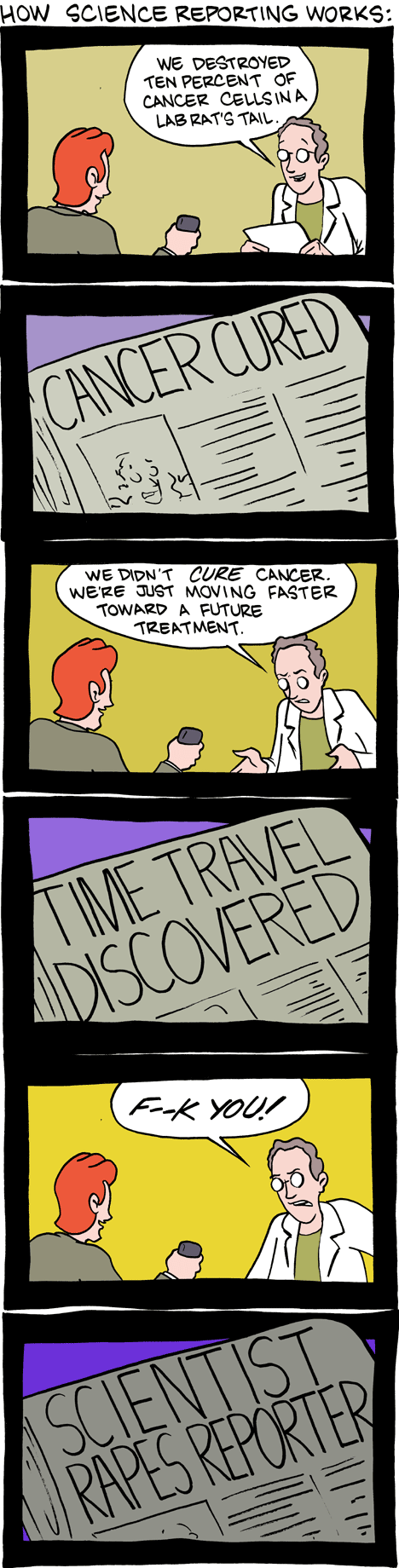
Today's PSA

Uncertain Principles: The Delete Key Is Your Friend

Look, people: the delete key is your friend. There is no need to send every bit of the exchange on to new people. If you’re only responding to the most recent email, do us all a favor and delete the rest of the quoted text. If you’re forwarding something on to a new audience, delete everything but the most essential part of the message. We don’t need to see all the deliberation that went into the decision to forward: just send the key message.

This is especially important when you use a free email system that tacks on twenty or more lines of crap at the end of the email, and all you’ve added is “LOL.”

Homo sapiens

Homo sapiens

Zoo visitors and staff have been surprised by the addition of a new and unexpected enclosure at Bristol Zoo Gardens.

A mysterious sign has appeared on the side of the Zoo’s popular Coral Café, designating the area as a place to spot one of the world’s most widespread species – Homo sapiens.

The notice, which appeared without warning this week, shows humans ‘on display’ inside the café and includes tongue-in-cheek description of the species and its characteristics.

My Turf

Built onFacts: Time and Navigation

Matt gives a brief summary of time and navigation. There’s one point that he glosses over, and it’s something that a lot of GPS summaries gloss over, to the point that they are misleading.

All a GPS satellite does is eternally broadcast two continuously updated pieces of information: its position and the time on its atomic clock. Knowing that light travels at about 1 foot per nanosecond, we can calculate how far we are from the satellite to the foot, as long as the GPS clock is accurate to the nanosecond and we have a receiver that can handle such a precise signal.

Actually you can’t do this unless you have a synchronized clock, and unless you’ve done this already, in order to synchronize the clocks properly you have to know … [wait for it] … the distance to the satellite. Many of the explanations of GPS completely miss this little tidbit. If you haven’t got a synchronized clock, and all you have are the GPS signals, you need four satellites to find your position. In practice four may not be necessary, because if you know your approximate position on the earth and have a topographic map, you can get the elevation from that, in which case three satellites is sufficient to get your position, to some level of uncertainty.

Grabbing the 'Aha' Moment

The US isn’t the only country having trouble teaching high-school physics. Australia has similar issues.

Physics teachers not up to scratch: study

One quote caught my eye:

“The person that’s teaching them might have some competence in science but just can’t grab that ‘aha’ moment.”

Not that I’m endorsing under-qualified high-school physics teachers, but I suspect that the ‘aha’ moment for science happens before high school. There are a lot of opportunities for teachers to turn students on, or off, before the teenage distractions show up in life. And physics tends to be taught last in high school science sequences, so the potential audience has already dwindled if students are turned off by chemistry or biology.

via

Not 'Ha Ha' Funny

Ozone threat is no laughing matter

Nitrous oxide (N2O) has become the greatest threat to the ozone layer, a new analysis suggests. The ozone-destroying abilities of the gas have been largely ignored by policy-makers and atmospheric scientists alike, who have focused on the more potent chlorofluorocarbons (CFCs) — historically the dominant ozone-depleting substances in the atmosphere.