
A Bootstrapping Problem

My glasses fell apart while I was attempting to clean them. The little tiny screw fell out, so the lens was no longer in a captive state, and the carpet in my office is not designed to make nanoscrews stand out to the casual (or even interested) observer, especially if you can’t wear your corrective lenses. Searching on hands-and-knees while holding a flashlight is a pain to do while simultaneously holding a lens in place.

Hence the conundrum. How do you find the screw, and fix your glasses, if you need glasses to see things like that?

A search, even while wearing my old (i.e. backup) glasses, revealed nothing. CSI training to the rescue! I took the dustbuster and emptied it and vacuumed around where I had been sitting. Then I opened it up and discovered the screw, along with a bunch of other stuff — I’ll be generous and say the custodial staff’s vacuuming efforts under the desk aren’t efficient because of space restrictions, rather than curse them for not bothering to vacuum under the desk. (I also discovered that my chocolate-chip granola bars have been shedding chips at a higher rate than I had thought, but these defectors had been camouflaged by the carpeting in low-light conditions)

Here’s the screw

nanoscrew

(Just kidding. That’s a novelty dime, about 3″ across)

So, success. I later checked and found that the screw is indeed ferromagnetic, but since the frames are Titanium, I wasn’t sure that a magnet would be a useful tool. My backup plan was to take a screw out of my backup glasses. The backup glasses themselves only represent a bare minimum of vision redundancy, because they are not bifocals. The few minutes of wearing them was a stark reminder of how crappy my near-field vision is — they were essentially no help at all in doing the repair work.

One other bootstrapping problem that confronts many physicists is this: I can’t function without my morning coffee. How do you make coffee without having had any coffee? Luckily I partake of caffeine in can form (artificially-sweetened), thus avoiding that issue.
ZZ Top Physics

Electrons in Rydberg states exhibiting behavior like classical orbits — Lagrange L points.

Rumour spreadin a-round in that Texas town
’bout that shack outside Lagrange

An astronomical solution to an old quantum problem

When a small satellite moves in a sun-earth system there are five stable points at which the satellite remains fixed with respect to the rotating sun-earth system. These are the famous Lagrange L points. In 1994 Bialynicki-Birula et al. showed that stable Lagrange points could be produced in the atomic electron problem by applying a circularly polarized microwave field rotating in synchrony with an electron wave packet in a highly excited state (a so-called Rydberg atom). The electron wave packet then remains localized near the Lagrange point while circling the nucleus indefinitely. Effectively the atom is made to behave quite classically.

via Zz

When Cakes Go Bad

Nah, These Won’t Traumatize the Kids at ALL

“Yay! Dead elephants!”

There’s also When Common Sense Isn’t, where the decorator has copied, rather than followed, the written instructions.

We Love Freymoto
put Heart in Place of Word Love

All at Cake Wrecks

A Cake Wreck is any cake that is unintentionally sad, silly, creepy, inappropriate – you name it. A Wreck is not necessarily a poorly-made cake; it’s simply one I find funny, for any of a number of reasons.

You're the Top

Fermilab collider experiments discover rare single top quark

Previously, top quarks had only been observed when produced by the strong nuclear force. That interaction leads to the production of pairs of top quarks. The production of single top quarks, which involves the weak nuclear force and happens almost as often as the strong force production, is harder to identify experimentally. Now, scientists working on the CDF and DZero collider experiments at Fermilab achieved this feat, almost 14 years to the day of the top quark discovery at Fermilab in 1995.

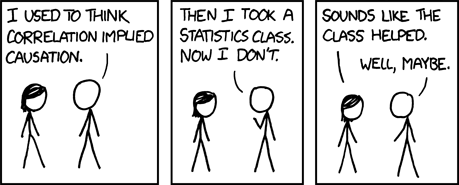
In this Corner, Correlation …

Friday’s XKCD was one of Randall’s better ones, and I see that Matt has already commented on it

>

It goes right to the heart of one of the greatest philosophical difficulties of science. All we can do is measure correlation. We can never be assured that we’re not just getting lucky and that in fact the fundamental-seeming physical laws we deduce are just flukes.

And this is true — science is inductive, and we draw conclusions rather than prove. What distinguishes science from superstition is what happens next. Correlation is the start, but can easily be wrong, which is the basis of the logical fallacy post hoc, ergo propter hoc (happened after, therefore was caused by). If one is not cognizant of this, one might notice that the US never used nuclear weapons until after women got the right to vote, and think there’s meaning to the correlation.

So we ask for more. What we can do is set up conditions where if the phenomenon does happen to be a fluke, that the odds of it being so are really, really small. (Flip a coin and get heads 10 times in a row? Doesn’t mean you have special powers. Do that significantly more often than once per thousand attempts and we’ll talk). That’s the power of statistics, and why a single event is not enough to demonstrate causation. But even then, there are potential pitfalls. Two correlated effects might be caused by a common factor. If you don’t consider this possibility, you might conclude that buying a Lexus causes people to vote Republican.

But even that isn’t enough. We also want there to be a plausible mechanism that we can model, and use that to predict other behavior. Then you test — can you turn the effect on and off, and do it in such a way that eliminates other explanations? And the tests must be rigorous, with specific predictions and carefully executed experiments. It’s only after that testing that the suggestive winking of correlation can be reasonably concluded as causation.

Those Kinky Alkali Atoms

Cross-dressing Rubidium May Reveal Clues For Exotic Computing

In their experiment, they cause a gas of rubidium-87 to form an ultracold state of matter known as a Bose-Einstein condensate. Then, laser light from two opposite directions bathes or “dresses” the rubidium atoms in the gas. The laser light interacts with the atoms, shifting their energy levels in a peculiar momentum-dependent manner. One nifty consequence of this is that the atoms now react to a magnetic field gradient in a way mathematically identical to the reaction of charged particles like electrons to a uniform magnetic field. “We can make our neutral atoms have the same equations of motion as charged particles do in a magnetic field,” says Spielman.

Cross-Dressing? Someone has broken into the liquor cabinet again.

Pipe Down!

Noisy Logic

As computer chips shrink ever smaller, the background flicker of electronic noise threatens to undermine the vital precision of digital processing. Unlike ordinary circuits, a newly designed digital circuit element only works properly when the noise level is sufficiently high. The circuit, described in the 13 March Physical Review Letters, is not only well-suited for noisy nanoscale operations, but it can also be changed on the fly to perform different logic functions–a property that could lead to reconfigurable computer processors.

Crossing Over

The Crossover Flywheel hockey training aid

You need to a flashplayer enabled browser to view this YouTube video

The one redeeming facet about when “I am the story” reporters try to participate in their pieces is that there’s the potential that they can get hurt.