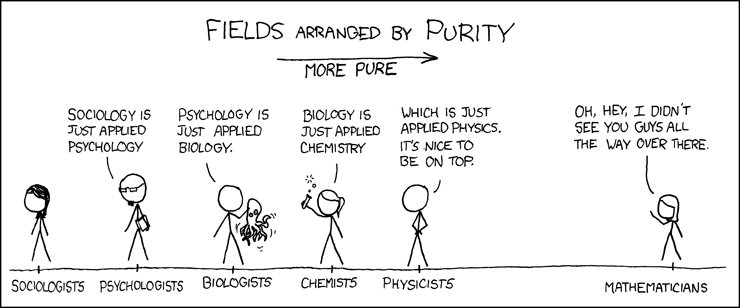

Tag: On the other hand, physicists like to say physics is to math as sex is to masturbation
Well, geez, I don’t say that, but I’m sure as hell gonna start.

Tag: On the other hand, physicists like to say physics is to math as sex is to masturbation
Well, geez, I don’t say that, but I’m sure as hell gonna start.
Squaring the Diamond illusion at Illusion Sciences
I “won” this a few summers ago at an arcade, after dropping about $5 in quarters into Skee-ball (and unDogmatically keeping the points for myself). I was on vacation, and Claire, a ~5 year-old staying a few doors down had won a similar Spidey inflatable Tombat (not its official name but certainly how it was being used) a few days earlier. Being the exact same age as Claire, this was my chance at escalation and revenge.
At work it has been used as a motivational tool on at least one summer intern.

The teaser for the evening news just showed a clip of cellphones purportedly popping popcorn, and asking the question of whether it’s a hoax. My money’s on yes. Wired has a story on it, and there’s more than one video.
Assume a kernel has 0.1 g of water in it. You need to heat it from ~20 ºC to 100 ºC and then boil it, which is what happens when you pop popcorn. The heat capacity is 4.18 J/g, and the heat of vaporization is 2260 J/g. So this requires 80*4.18*0.1 +2260 * 0.1 = 260 Joules. This happens in a few seconds, so the absorbed power is somewhere around 50-100 Watts, per kernel. The transmitted power of the phones would have to be much, much larger, since it’s not focused on the popcorn.
Not.
Google also tells me that Zapperz beat me to the punch here.
Update: It looks like I overestimated the water content by a factor of about 5 (see link in comment 2; I assume medium-large kernels, though, not small. Orville has standards). Doesn’t change the overall answer. It takes my microwave oven ~3.5 minutes to pop my popcorn. A few hundred Watts for a (few) hundred kernels so let’s call it 1 Watt per kernel for 270-330 seconds (onset of popping is at about 2.5 minutes). That matches up pretty well with the numbers above, which we now know are overestimated. I see no reason to hypothesize that only infinitesimal boiling is happening.
Conn. police find pipe bomb stuffed inside chicken
The road was closed while the Hartford Police Department’s bomb squad came and blew up the chicken.
Sorry I’m late. I was waiting for someone to blow up the chicken.
I was poking around the toobz (looking for a citation or link to something about “slow light”) and ran across this press release from last year that made me clench and then start grinding my teeth. I have no idea who vets these things, but OMFG, it’s bad. The press latches onto these ideas that are just wrong, and use cutesy buzzwords and phrases to try and connect the story to the urban-legend version of physics that the popular-press readers know, partly because that’s what gets fed to them by the popular press. It becomes that much harder to undo the damage once the bad information gets ingrained, much like when superluminal physics gets reported, only to invariably find it’s anomalous dispersion, and nothing has “broken the lightspeed barrier” or in any way violated relativity.
Here’s the press release: Light and Matter United
Let me say, at the outset, that Lena Hau, et. al, do some amazing, quantum jaw-dropping atomic physics, and I’m not making any arguments or objections about that work. What I’m critiquing is how that work is being reported.
Lene Hau has already shaken scientists’ beliefs about the nature of things. Albert Einstein and just about every other physicist insisted that light travels 186,000 miles a second in free space, and that it can’t be speeded-up or slowed down. But in 1998, Hau, for the first time in history, slowed light to 38 miles an hour, about the speed of rush-hour traffic.
It’s well-known that light traveling through a medium does so at a speed slower than c, and the light that was slowed down wasn’t in a vacuum, so WTF? It was in a specially-prepared sample of a Bose-Einstein Condensate (BEC), called Electromagnetically-Induced Transparency (EIT), which creates a narrow window (in frequency-space) where light won’t be absorbed, and near a resonance you get a change in index of refraction. A rapidly-varying index of refraction, as you get here with a sharp resonance, will slow down the group velocity of light by a large factor. As one can read in the paper (pdf),
[W]e obtain a nonlinear refractive index of 0.18 cm2W-1. This nonlinear index is ~106 times greater than that measured in cold Cs atoms
So the experiment was way cool, but not something that shakes one’s belief about relativity, and the whole bit about the speed of light in a vacuum is a head-fake.
Continue reading
Via Talk Like a Physicist, an ad campaign by Science World in Vancouver BC. (and I have a vague recollection of visiting it back when I lived slaved there as a postdoc)

I can’t find any link to this at the Science World web site but then this is apparently from a little while ago (other ads I found are dated 2006). So I can’t verify what was said in the pamphlet that was supposed to be included with the scale, because, of course, you only “weigh less” as long as the elevator is accelerating down. After it reaches “cruising speed” you weigh the same, and when it accelerates in the upward direction to bring you to rest, you “weigh” more, all happening on the way down. This reminds us that the scale is measuring the normal force, and not the weight, which is what I hope the pamphlet pointed out.
Another way to test this is to jump right as the accelerator starts down. In the ones that really zip, you can hit your head on the ceiling as the elevator accelerates while you are in a ballistic trajectory.

Kerning is the adjustment of the spacing between letter pairs in printing. Improperly done, (overkerning?) this can make letters run together, and e.g. “rn” is difficult to distinguish from “m,” especially for those of us with less-than-perfect eyesight. (And take care not to shove your “L” too close to your “I” since that could be a real FLICK-UP.) This leads to the creation of the term keming: improper kerning.
I yeam for thee, my heart bums when you are dose.
Dangers of keming
MEGAFLICKS
Trick or Treat
Still catching up from more than a day (and more than a blog-cycle) without power. Guide for the Amateur Physicist, which (if I were to have input) might be subtitled “This is why your missive isn’t science,” or, if I were Mike Myers in an SNL sketch, it might be “If it’s not physics, it CRAP!”
[U]ntil your theory can be described mathematically, it has no hope of making clear predictions about the results of experiments. You must be able to get actual numerical answers to problems using your theory. This is an ironclad requirement.
Which renders the (unfortunately all-too-common) “My ‘theory’ has no math. Can you please verify it?” inquiry moot.
Science Education for Everyone: Why and What? over at physics and physicists. A commentary on an article at redOrbit.
The original article makes several good points but, unfortunately, also build a strawman or two.
A common response to the notion of teaching all of the sciences is the claim that the standard type of courses really teach something called the “scientific method,” and that this will magically give students the background they need to read the newspaper on the day they graduate. This argument is so silly that I scarcely know where to start commenting on it. If it were applied to any other field, its vacuity would be obvious; after all, no one argues that someone who wants to learn Chinese should study French, acquire the “language method,” and learn Chinese on his or her own. If we expect our students to understand the basic principles of ecology or geology, we should teach those principles explicitly. To do otherwise is to indulge in what I call the “teach them relativity and they’ll work out molecular biology on the way home” school of thought. Incidentally, the notion that there is a magical “scientific method” explains a bizarre feature of the modern scientific community. I am referring to the fact that, outside of their fields of specialty, professional scientists, as a group, are probably the most scientifically illiterate group in the United States. The reason is simpie: scientists are never required to study science outside of their own fields. The last time a working physicist saw a biology textbook, for example, was probably in high school. If you do not believe me, ask one of your scientific colleagues how he or she deals with public issues outside of his or her field. Chances are you’ll get an answer like “I call a friend,” a technique I refer to as having recourse to the Golden Rolodex.
Zapperz critiques this, and I’ll add my two cents. That there is no single “scientific method” is one of the things that we should be teaching. One does not learn French to learn Chinese, but one can develop an appreciation of language by recognizing that there are differences (and similarities) in the structures of different languages. Likewise, a teacher can point out the was that the scientific method manifests itself in their particular discipline when teaching a physics/biology/geology for poets class. Expose them to the fact that “theory” does not mean “guess.” Make them recognize the interconnectedness of science so that when someone makes a statement that is too far advanced for their level of expertise, they understand that it’s not a scientist just making stuff up. Teach them some analytical thinking. Develop their bullshit detector a little bit. Make them learn something. This isn’t an either/or situation.
