Find the amount you’d have to drink of your favorite beverages and/or eat foods to get a lethal dose of caffeine.
473.96 cans of Diet Wild Cherry Pepsi + You = Death.
Whew! For a moment, I thought I was in trouble.
via Physics Geek
Find the amount you’d have to drink of your favorite beverages and/or eat foods to get a lethal dose of caffeine.
473.96 cans of Diet Wild Cherry Pepsi + You = Death.
Whew! For a moment, I thought I was in trouble.
via Physics Geek
From our “Plan of the Week”
————
August 12 & 17 1877 – Asaph Hall discovers the moons of Mars. From Halls’ notebooks: I repeated the examination in the early part of the night of [August] 11th, and again found nothing, but trying again some hours later I found a faint object on the following side and a little north of the planet. I had barely time to secure an observation of its position when fog from the River stopped the work. This was at half past two o’clock on the night of the 11th. Cloudy weather intervened for several days.
On 15 August the weather looking more promising, I slept at the Observatory. The sky cleared off with a thunderstorm at 11 o’clock and the search was resumed. The atmosphere however was in a very bad condition and Mars was so blazing and unsteady that nothing could be seen of the object, which we now know was at that time so near the planet as to be invisible.
On August 16 the object was found again on the following side of the planet, and the observations of that night showed that it was moving with the planet, and if a satellite, was near one of its elongations.
Until this time I had said nothing to anyone at the Observatory of my search for a satellite of Mars, but on leaving the observatory after these observations of the 16th, at about three o’clock in the morning, I told my assistant, George Anderson, to whom I had shown the object, that I thought I had discovered a satellite of Mars. I told him also to keep quiet as I did not wish anything said until the matter was beyond doubt.
He said nothing, but the thing was too good to keep and I let it out myself. On 17 August between one and two o’clock, while I was reducing my observations, Professor Newcomb came into my room to eat his lunch and I showed him my measures of the faint object near Mars which proved that it was moving with the planet. On August 17 while waiting and watching for the outer moon, the inner one was discovered. The observations of the 17th and 18th put beyond doubt the character of these objects and the discovery was publicly announced by Admiral Rodgers.
————
This was from a time when the Observatory was located at Foggy Bottom — it was about 16 years later that it was moved to its current location. But the same telescope is still in use.
(And it’s probably a good thing Hall didn’t discover the moons as a university professor, because then the Astronomy building named after him would be Asaph Hall Hall)
A pretty cool experiment that puts a lower bound on a speed of entanglement has been performed. The experimenters entangled photons, separated them, and then made their measurements.
Physicist Nicolas Gisin and colleagues at the University of Geneva in Switzerland split off pairs of quantum-entangled photons and sent them from the university’s campus through two fiber-optic cables to two Swiss villages located 18 kilometers apart. Thinking of the photons like traffic lights, each passed through specially designed detectors that determined what “color” they were when entering the cable and what color they appeared to be when they reached the terminus. The experiments revealed two things: First, the physical properties of the photons changed identically during their journey, just as predicted by quantum theory–when one turned “red,” so did the other. Second, there was no detectable time difference between when those changes occurred in the photons, as though an imaginary traffic controller had signaled them both.
The results show that any information connection between them would have to occur at at least 10,000 times the speed of light, which is interpreted as a pretty good indication that it’s an inherent behavior of quantum mechanics, and this “communication” isn’t actually taking place. (see also Bohm’s Bummed and the summary at Physics and Physicists)
Or not.
nature news has an article entitled Physicists spooked by faster-than-light information transfer. LiveScience’s article is Spooky Physics: Signals Seem to Travel Faster Than Light. Which is really strange, because at least in the nature summary, they discuss how it isn’t evidence of superluminal communication
A second test ensured that the scientists in the two villages weren’t missing some form of communication thanks to Earth’s motion through space. According to Einstein’s theory of relativity, observers moving at high speeds can have different ‘reference frames’, so that they can potentially get different measurements of the same event. The Geneva results could possibly be explained if the two photons were communicating through a frame of reference that wasn’t readily apparent to the scientists.”
But theoretical calculations have shown that performing tests over a full spin of the globe would test all possible reference frames. The team did just that, and they got the same result in all cases.
The bottom line, says Gisin is that “there is just no time for these two photons to communicate”.
So why use a headline that says or implies that there is FTL information transfer, when the conclusion is that there isn’t?
Are we science-savvy enough to make informed decisions?
Let me guess: no. I mean, really, is this a gimme or what?
Seventy-six percent of Americans say presidential candidates should make improving science education a national priority, according to a national Harris Interactive survey of 1,304 adults in November and December. Results were released this spring.
But only 26% believe that they themselves have a good understanding of science. And 44% couldn’t identify a single scientist, living or dead, whom they’d consider a role model for the nation’s young people.
So at least some of those possessing marginal scientific literacy recognize that science education is important.
It boils down to this — if you can’t make the informed decision yourself, then you’re going to fall for whoever can lie most convincingly. And I think that accomplished liars have an advantage.
There is also a link to a quiz, which looks like the NSF Science and Engineering Indicators quiz. Unfortunately, we are told
10 or 11 right: You are a geek!
Maybe some small part of the problem is that basic science competency is being identified as geeky, though somehow I doubt that USA TODAY is the arbiter of cool amongst today’s teens.
Udate: commentary at Physics and Physicists
Matt discusses the disaster of grades in The Final Countdown
I just finished grading three problems worth of the final exam (the other two TAs are taking care of the rest), and I think the exam can be safely described as a debacle. It was a disaster. The scores haven’t been tallied up yet, but I think there’s a good chance the mean score will be within one standard deviation of zero. And, I dunno, about 4 or 5 standard deviations away from 100.
One mitigation technique I’ve mentioned before is to have a database of questions, so that you know the expected results, but this doesn’t necessarily work well in a university environment, and doesn’t apply here as it was already noted that the exam was made from scratch.
But there’s another option. I’ve taken and TA’d several classes where grades were neither curved, strictly speaking, nor were graded on a standard “90 and above is an A” basis. The professor who taught the class for which I TA’d pointed out that the students had a hard time adjusting to the concept that the average score was going to be about 50, since they had never encountered that system before. When it first happened to me as an undergraduate, the professor put it rather succinctly — why bother asking a lot of questions that everybody can answer? If 65 is the lowest passing score, then you’re asking a whole bunch of points worth of questions that don’t demonstrate adequate knowledge of the material. The idea was to cut out 50 points of that and add in questions that do require “passing” knowledge to answer and adjust the grading accordingly. The exams were much more complete in testing comprehension, since you could ask more questions about a particular topic. It’s not unlike the strategy taken during oral exams — asking questions until the target can’t answer them anymore. That’s when you’ve tested the depth of knowledge and comprehension.
Another cool find by Zapperz: Threading Light Through the Opaque
Freshly fallen snow is blinding white because the jumble of flakes scatter light in all directions. Such scattering also implies that little light passes through snow, so that if you’re ever buried deep in it, you’ll find yourself in the dark. But according to theoretical physicists, it should always be possible to fiddle with light waves to make them wend their way through such a disordered material, no matter how thick. And now a duo of experimenters has demonstrated that feat.
Cities play hardball to host biodefence lab
The Department of Homeland Security (DHS) disregarded the advice of carefully selected experts to put a Flora, Mississippi, site on the shortlist of candidates, the Associated Press said Monday.
[…]
Now, other applicants are crying foul. “It is very suspicious,” said Irwin Goldman, whose Madison, Wisconsin, site failed to make the cut. State representative Marti Crow (D) of Leavenworth, Kansas, was angry that Flora’s score of 81 beat out Leavenworth’s 92 for a spot on the shortlist.
Wait, what? Biodefence lab? Mississippi? Kansas? How about a rule that any state that’s recently tried to derail the teaching of evolution or promote creationism/intelligent design doesn’t get a frikkin’ federally-funded biology lab in their state.
Zapperz has a short post on an article that appeared in the NY Times, chumming the waters of fear about radiation from granite countertops. I see that Chad has promised and delivered a bit of a rant, pointing out that popular media could and should do science. The problem is that they don’t — not in the living section, and sometimes not in the science section, and almost certainly not on the op-ed page.
But that’s not actually what piqued my interest here. It’s mediocre reporting, to be sure; the author makes sure to give “both sides” of the story, even though science boils down there being experimentally verified claims or not, so reporting knee-jerk reactions to the ticking of a geiger counter isn’t particularly responsible. But there was a snippet that reminded me of a conversation I was having last week.
Indeed, health physicists and radiation experts agree that most granite countertops emit radiation and radon at extremely low levels. They say these emissions are insignificant compared with so-called background radiation that is constantly raining down from outer space or seeping up from the earth’s crust, not to mention emanating from manmade sources like X-rays, luminous watches and smoke detectors.
And not to mention — because they don’t — people. That’s right: YOU are radioactive. An adult contains something like 140 g of potassium, of which about 16.5 mg will be K-40, which is radioactive with a 1.26 billion year half-life, yielding about 4400 decays per second. You also have C-14 in you, adding in another 3000 decays per second. The C-14 decay, and 89% of the K decays give betas, which will be deposited in your body. The other 11% of the K-40 decays have a 1.46 MeV gamma, and about half of them will be deposited in your body as well. This ends up being tens of millirem of dose per year.
The rest of the gammas escape, which means that you are a 6.5 nanoCurie gamma source. (Sleep with someone else 8 hours a night, all cuddled up? That’s around a millirem of dose each year. Not a cuddler? Here’s your excuse — your exposure decreases as you move away.) Do you use potassium in your water softener or as an alternative to table salt? What about bananas? That’s a 300 picoCurie source there, and you’re eating it. If you leave it alone, it’s only about 20 picoCuries of gamma.
The point here isn’t to make anyone afraid of bananas. You need potassium, and K-40 is along for the ride. But reporting like this gives no context, and paints a very simplistic “all radiation is bad” picture, when some dose is simply inescapable. It accentuates and panders to our inability to properly assess risk for unusual circumstances, especially with the mention of radon testing kits at the close of the article.
Slow-motion lightning.
Oh, ratfarts, that’s cool.
(In case of a thunderstorm, stand in the middle of the fairway and hold up a one iron. Not even God can hit a one iron. Lee Trevino)
Michael Phelps has more going for him than immense talent. In Quest for Speed, Olympic Swimmers Use Physics over at Physics Buzz. There’s a brief discussion of the fluid mechanics topics involved in improving swim times, from analysis of swimmers’ motions to the pool design that reduces turbulent water to the new swimsuits.
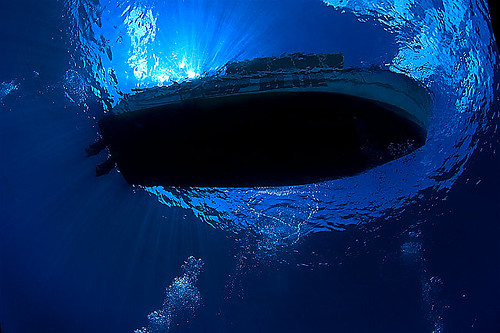
But what goes unmentioned is the underwater photo, showing the phenomenon known as Snell’s Window. Snell’s law tells us that light moving from one index to another will refract; light entering the pool on its way to the camera must bend toward the normal, meaning that the light entering the lens is compressed from a hemisphere into a cone, and the index of water (1.33) dictating the cone’s apex of 97.5º. Outside of that angle we have total internal reflection from the pool’s bottom; this light cannot escape the pool as it can’t refract and enter the air.
Here’s another picture showing Snell’s Window.